Network Operations Intelligence

What do NetOps teams do when traditional monitoring’s not enough?

Network Operations Intelligence brings together complete network data and AI-driven analysis so NetOps teams can understand their environment, find the root cause of problems, and know what to do next. It also helps teams anticipate risks, maintain standards and compliance, and make informed decisions about network spending.

The Six Domains of Network Operations Intelligence

Network Operations Intelligence is the continuous collection, correlation, and AI-driven analysis of complete network infrastructure data to answer operational questions, identify root causes, predict problems, and guide corrective action.
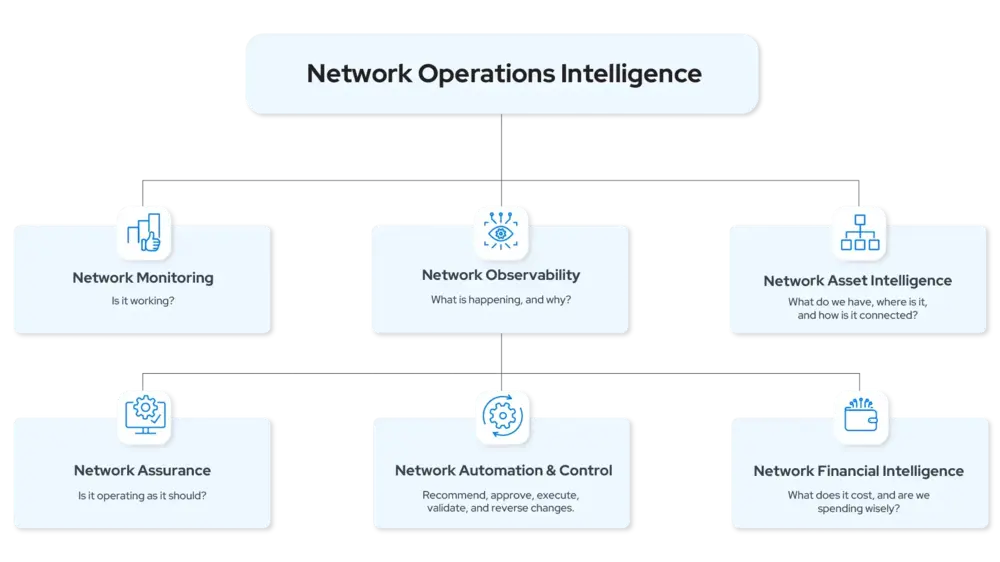
Network-Operations-Intelligence_v2_1800x1011


Network Monitoring

Is the network working?

Continuously track network health, performance, and availability. Catch emerging issues before they become more serious.

  • Monitor devices, interfaces, links, applications, and services
  • Track utilization, latency, packet loss, response time, and device health
  • Detect outages, degradation, congestion, errors, and abnormal conditions while maintaining historical performance data

Network Observability

What's happening, and why?

Put network behavior in context by connecting relevant data, events, paths, and dependencies that can explain how an incident unfolded.

  • Correlate metrics, events, logs, traffic flows, configurations, and topology
  • Show the complete path between users, devices, applications, and services
  • Preserve historical state so teams can investigate when, where, and how network behavior changed

Network Asset Intelligence

What do we have and where is it? How is it connected?

Maintain an always-current view of the devices, endpoints, connections, and lifecycle details that make up your network.

  • Discover network equipment, connected endpoints, and other infrastructure automatically
  • Track manufacturers, models, serial numbers, software versions, addresses, and physical locations
  • Map interfaces, topology, VLAN membership, routes, and device relationships
  • Identify unknown, obsolete, unsupported, or unmanaged equipment

Network Assurance

Is the network operating as it should?

Continuously compare network behavior and configuration against the intended state. 

  • Standards and Compliance Validation: Validate network configurations and security controls against requirements supporting PCI DSS, HIPAA compliance, as well as other standards, identify gaps, and guide corrective action.
  • Detect configuration errors, inconsistencies, drift, and unauthorized changes
  • Validate redundancy, resiliency, routing, failover, capacity, and service-delivery requirements
  • Identify security exposures, unsupported systems, and operational vulnerabilities
  • Measure service levels and prioritize risks by operational and business impact

Network Automation & Control

What needs to change, and how do we act on it?

Turn findings into corrective action, with changes applied consistently and tracked from request to result.

  • Recommend corrective actions based on root cause and operational impact
  • Automate routine tasks such as configuration backups and compliance remediation
  • Push approved configuration changes consistently across devices and sites
  • Log every change with a full audit trail for review and rollback

Network Financial Intelligence

What does the network cost, and where can we optimize that investment?

Connect infrastructure, utilization, contracts, and lifecycle information to the financial side of running the network.

  • Track purchase costs, subscriptions, licenses, maintenance, support, warranties, and renewal dates
  • Associate spending with devices, locations, departments, services, vendors, or technologies
  • Identify unused circuits, underutilized capacity, redundant licenses, and unnecessary support coverage
  • Support refresh planning, budgeting, renewal negotiations, and capital forecasting

Network Security Intelligence

Is the network enforcing the organization’s security policies?

Helps NetOps teams implement, verify, and maintain the network controls required by the organization’s security policies.

  • Identifies unauthorized, unmanaged, or suspicious devices connected to the network
  • Detects vulnerable network equipment, operating systems, and firmware
  • Evaluates routers, switches, firewalls, and wireless infrastructure against security-hardening standards
  • Identifies insecure protocols, services, management interfaces, and configurations
  • Validates network segmentation, VLAN boundaries, ACLs, and permitted traffic paths
  • Determines whether security controls are consistently implemented across locations and vendors
  • Detects configuration drift that weakens the network’s security posture
  • Maps vulnerabilities to affected devices, interfaces, locations, and connected systems
  • Identifies potential lateral-movement paths and areas of excessive network access
  • Verifies that required logging, monitoring, authentication, and encryption controls are enabled
  • Translates Security-team mandates into specific actions for NetOps
  • Provides evidence that required network security controls are operating correctly

Beyond Monitoring and Observability

See what your network can tell you when AI has the complete picture.

Talk to Us